
No.121 — Read old posts on Tinyfarmlab.com
Reading Time 5 minutes
Ask anyone in natural building to name their heroes.
You'll hear Hassan Fathy,
who built for the poor of Egypt.
Anna Heringer and her handmade school in Bangladesh.
Didi Contractor in the Kangra valley.
Yasmeen Lari in Pakistan.
Shagun Singh at Geeli Mitti.
All giants.
All deserving.
But there is one name that rarely comes up.
A woman who built with mud for four decades.
Who put mud walls inside a 13,000 square metre museum?
Who built mud homes for the wealthy in Delhi
and mud schools for the poorest children in Bhopal.
Her name was Revathi Kamath.
And this week, we want to introduce you to her.
Who was she?
Revathi Kamath was born in 1955 in Bhubaneswar.
Her father was a civil engineer on the Hirakud Dam.
She studied architecture at the School of Planning and Architecture, Delhi, worked with masters like Joseph Allen Stein and B.V. Doshi, and in 1981 started a practice with her husband, Vasant Kamath.
She could have had a comfortable career designing in concrete and glass.
Instead, she chose mud.
Not just as a hobby.
Not as an experiment.
As a forty-year mission.
"My whole effort is to make mud a viable material."
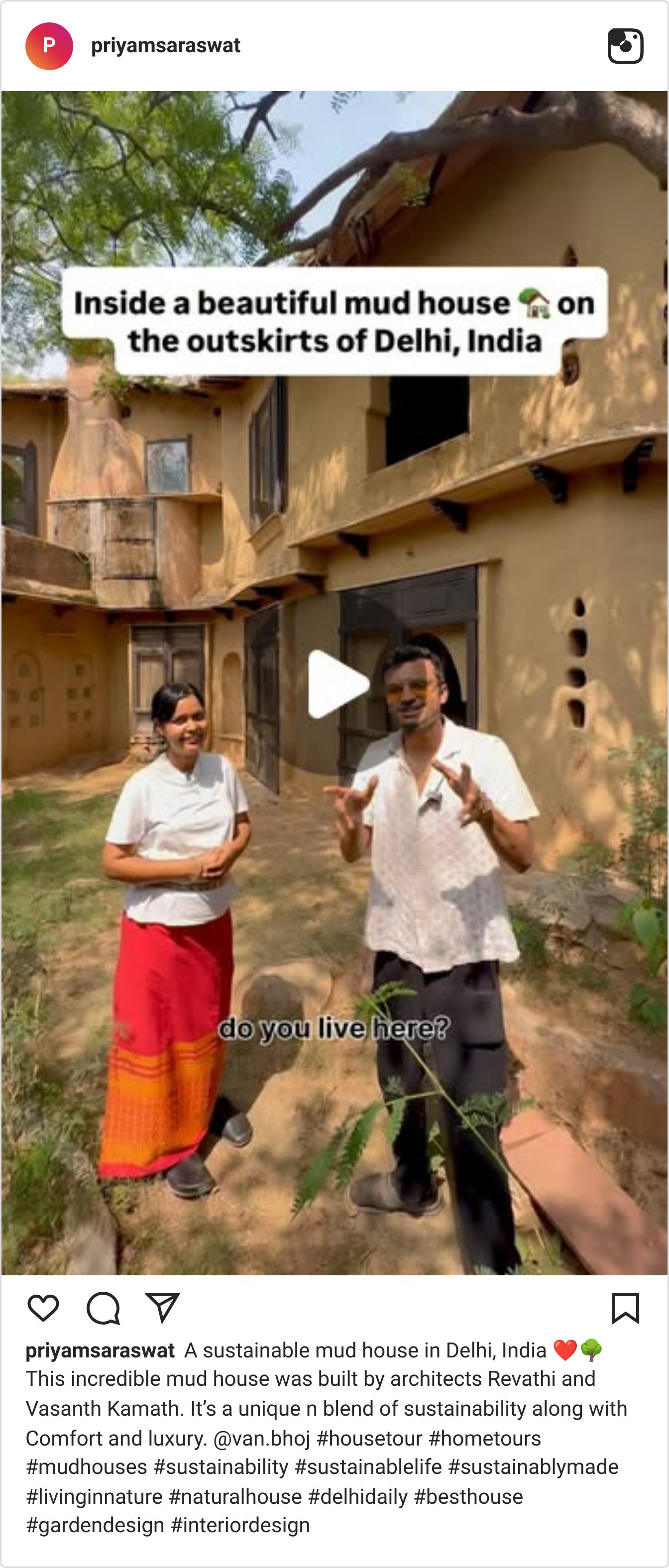
In the early 1990s, Revathi built her own home
in Anangpur village near Faridabad on land devastated by quarrying and mining.
It’s now run and maintained by Prerna of Ecoplore and goes by the name Van Bhoj.

The mud came from the site itself,
dug from four feet below the surface.
The topsoil was carefully put back as a living roof.
The bricks were sun-dried, a foot thick,
strong enough to carry two storeys.
The foundations were local stone laid in lime.
The roof was alive with grass growing overhead on bamboocrete.
The whole house used just 0.3% cement.
Almost everything in it could return to the earth.
This was 1992.
Decades before "sustainable architecture" became a hashtag,
She was already living it.
And here's the detail we love most:
The house was built largely by women and elderly workers.
Mud is not just for the poor
For a hundred years, cement companies have told us
that mud is what you build when you can't afford better.
Revathi spent her life dismantling that lie.
She built the Desert Resort in Mandawa, Rajasthan, a luxury resort in mud.

Deser Resort at Mandawa, courtesy: Kamath Design Studio
A museum built by the people it celebrates
Her largest canvas was the Museum of Tribal Heritage in Bhopal.
Commissioned in 2004. Completed in 2013.
Nearly a decade of work.
Eight acres. 13,000 square metres.
In Madhya Pradesh, over 30% of the population is tribal.
So Revathi asked a radical question:
What if the museum wasn't just about tribal communities...
but built with them?
The exhibits were created by tribal artisans themselves.
The walls were finished in mud plaster.
The galleries follow the contours of the land,
opening into courtyards of light and air.

A school made of smiles
In 2016, she designed a school in Bhopal for Muskaan,
an NGO working with children from denotified tribal communities,
communities that colonial law once branded "criminal by birth,"
and that still live on the margins today.
She did it pro bono.
Sun-dried mud bricks, made on site.
Local sandstone, bamboo, recycled wood.

Courtesy: Kamath Design Studio
And the builders?
The children's own families.
Construction workers who, for once,
weren't building someone else's dream.
The community calls it Mitti ka Qilla.
The fort of mud.
We were lucky to have witnessed this school in person on our recent trip to Bhopal.
It definitely takes audacity and courage to build a school with mud at this scale.
The architect of contradictions.
There was so much to learn about detailing a G+1 mud building.
“Vernacular is indeed more sustainable.
Vernacular is something that belongs to the people and place.”
Here's the part that surprises most people.
The woman who championed the humblest material on earth
also designed the tallest stainless steel structure in South Asia,
a 33-metre gateway in Raigarh, Chhattisgarh, for Jindal.
It seems like she wasn't against technology.
She was against thoughtlessness.
"Most of the architecture is to establish power,
to impose yourself on the environment...
and somehow I don't find my repose
in that kind of creativity"
So why don't we know her?
Revathi Kamath died on July 21, 2020,
just ten months after Vasant.
Three of her projects were nominated for the Aga Khan Award.
She won recognition late in her life.
But she never became a household name.
Maybe because she was too busy building.
Maybe because the world wasn't ready to celebrate
an Indian woman who chose mud over cement.
When asked which of her projects was her favourite,
she gave an answer we think about often:
"My favourite is the next one.
The one that's yet to come."
Which unsung natural builder should we write about next?
Reply to this email and let us know.
Love and light,
Raghav and Ansh
P.S. - If you are on LinkedIn, let’s connect! You can also watch our previous videos on YouTube and subscribe to our channel as we publish more videos soon.
What you can watch -
What you can listen to -


If you found value in this newsletter, please consider sharing it with a friend.
Tiny Farm Friends Newsletter.
Every week, we share tiny, valuable lessons to help you transition to the countryside and build naturally.
