
No.126 — Read old posts here.
Reading Time: 5 minutes
“So, you’re architects?”
“Yes, ma’am.
We are architects.
We run a material-driven architecture
and interior design studio.
It’s called Tiny Farm Lab.”
This is how most of our consultation calls begin.
Because most of you know us
as two hippie brothers
who quit the city
to build a house out of mud.
The house has many names.
Harry Potter fans call it Hagrid’s Hut.
Lord of the Rings fans call it a Hobbit House.
We call it what it is.
A hand-sculpted cob house.

Picture Credits: Atik Bheda
We wanted it to be whimsical.
We never wanted it to be a theme park.
We wanted to build it slowly.
Carefully.
With our own hands,
and the hands of a community
that loved it into being.
It was a demonstrator.
A question we asked with mud:
Can this be done properly?

Picture credits: Atik Bheda
From foundation,
to roof,
to the last coat of plaster.
With the comforts
a city person refuses to give up.
Workshops teach you things.
Books teach you more.
But mud only tells the truth
to the hands inside it.
We wanted to know
what works,
what cracks,
what falls,
before we told anyone else
how to build their dream.
In April 2024,
we finished Tiny Farm Fort.
Or rather,
we abandoned it.
Creatively.
A house is never finished.
It just starts being lived in.
So we opened it on Airbnb,
for strangers to sleep
inside mud walls
and wake up a little changed.
Then came the love.
From friends.
From strangers on the internet.
From newspapers, magazines, award juries.
We won the AD New Wave Award and the Kohler Bold Design Award.
Ansh won the Forbes 30 Under 30 Asia.

We are extremely grateful.
And then something funny happened.
The house got louder than us.
People thought it was our first project.
And our last.
Two brothers,
running an Airbnb in the hills.
We can’t blame them.
Our website hasn’t moved since.
Partly because we are lazy.
Mostly because we’ve been busy.
Too busy building
to write about building.
So what have we been up to?
A lot of mud.
Some lime.
A little straw.
And a few things we didn’t see coming.
Mud in the city
In the heart of Varanasi,
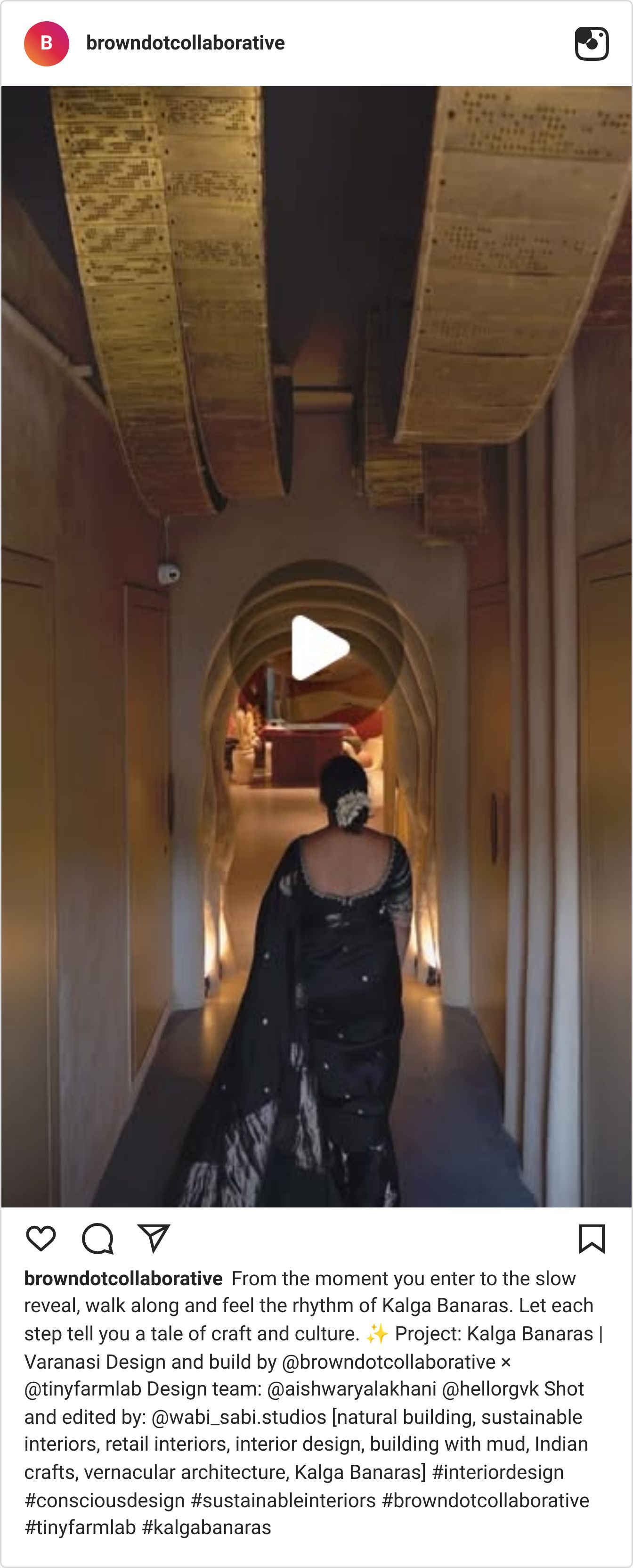
we hand-crafted Kalga Banaras,
a boutique saree store
made with mud and endangered crafts.

Picture Credits: Wabi Sabi Studio
We built it in collaboration with Brown Dot Collaborative.
In five months.
A record for us.
A testament that mud can perform under deadlines.
Old houses, new life
In Rishikesh,
a 90-year-old haveli
had lost its shine
as the lime plaster had been painted over,
several times.

We brought it back
by redoing the lime plaster,
with the help of lime artisans from Rajasthan
whose hands remembered
what our buildings have forgotten.
In Agra,
an old adobe house
that wasn’t used by the owners,
because it lacked the finesses and comforts
was renovated to accommodate their modern needs,
and replastered with advanced natural plasters
to reduce annual maintenance.

WIP photo received from the site.
Many more cob houses
One cob house in Rishikesh
is almost finished.
Another, on the outskirts of Rishikesh,
is waiting for the cob walls to go up.

Can cob scale?
Everyone asks this.
In Bandhavgarh Tiger Reserve,
we are building a resort
of eight cob cottages.

Three are rising together.
Two have reached the roof.
One cottage is a craft.
Eight is a system.
Going up
Cob usually stays on the ground.
In Sarnath,
we are designing a G+1 boutique resort,
a ground floor with one more on top,
using cob and reused red brick columns.

We’re working it out
with structural designers
and the local by-laws.
Because a mud building
that can’t get approved
is just a beautiful idea.
Straw, not smoke
Every winter,
North India burns its crop residue.
And its cities choke.
We think that straw
should become walls,
not smoke.
With the Godrej Design Fellowship,
we are building a straw bale prototype
in Mussoorie.
A low-carbon home for Himalayan towns,
made from what we usually burn.

And with Journey Across the Himalayas,
we are designing a pavilion
for their annual exhibition,
using prefabricated structural straw bale insulated panels (SSIP).
Playing in the forest
Not everything we make is a building.
The forests around us
are full of materials
we’ve forgotten how to use.
So we host residencies.
We research.
We play.

Bhimal fibre rope bags.
Hempcrete sculptures.
Mycelium artworks.
Kombucha leather pouches.

The aim is to allow yourself the luxury of failing
and, in doing so, pushing boundaries.
Many lands, many palettes
We have always believed that
India is not just a country,
it’s a continent with such diversity
in cultures, landscape, and materials.
We are grateful for the opportunity to work across the states.
From Phalodi in Rajasthan,
one of the hottest districts in India,
to a tropical hillside in Maharashtra
looking over a dam.
Every bioregion
hands us new crafts,
a new palette of materials,
and one more lesson
in listening to the land.
We built one house
to see what mud could do.
Turns out,
it can do a lot more
than we ever asked of it.
Our work now explores how architecture,
furniture and objects
can emerge directly from their landscapes,
shaped by local materials,
climate, craftspeople
and cultural memory.
We work with earth, stone, lime, timber,
and agricultural waste to develop
contemporary forms and material systems
that are low-carbon, biodegradable
and hand-crafted,
while remaining durable, aspirational,
and relevant to modern contexts.
So, are we architects?
Yes.
By education and by profession.
But we’d rather be called
natural builders.
Because we still get mud on our hands.
On every site.
We train a local team
wherever we build,
so the skill stays
after we leave.
Is this for you?
Maybe you have a piece of land.
Maybe an old house
you can’t bear to demolish.
Maybe you’ve looked at concrete
and toxic paints
and thought,
there has to be another way.
There is.
And we’d love to help you find it.
How do we begin?
With a conversation.
One call.
We listen to your land,
your budget,
your dream.
We tell you honestly
what’s possible
and what isn’t.
Sometimes the answer is cob.
Sometimes it’s stone and lime.
Sometimes it’s
“Please don’t build yet.”
We’ll tell you that too.
Book your consultation here.
Thank you for being part of this journey,
and for cheering us on,
through every wall,
tiny and big.
Love and light,
Raghav and Ansh
P.S. - If you are on LinkedIn, let’s connect! You can also watch our previous videos on YouTube and subscribe to our channel as we publish more videos soon.
What you can watch -
What you can listen to -
What You Can Read -

If you found value in this newsletter, please consider sharing it with a friend.
Tiny Farm Friends Newsletter.
Every week, we share tiny, valuable lessons to help you transition to the countryside and build naturally.
